Makers
A vertical distillery in a working harbor, a repurposed smokehouse on Loch Lomond, a longhouse in Inverclyde: Scotland's newest distilleries are being designed like statements.
For a century, a Scotch distillery looked like one thing: a pagoda-roofed block in a glen, preferably with a burn running past it. Scotland's newest distilleries have broken the template. In Leith, a distillery climbs nine storeys into the sky. On the banks of Loch Lomond, whisky is made in a repurposed smokehouse. In Inverclyde, the first new distillery in more than a century is built like a Viking longhouse. The architecture has become part of the argument the whisky is making.
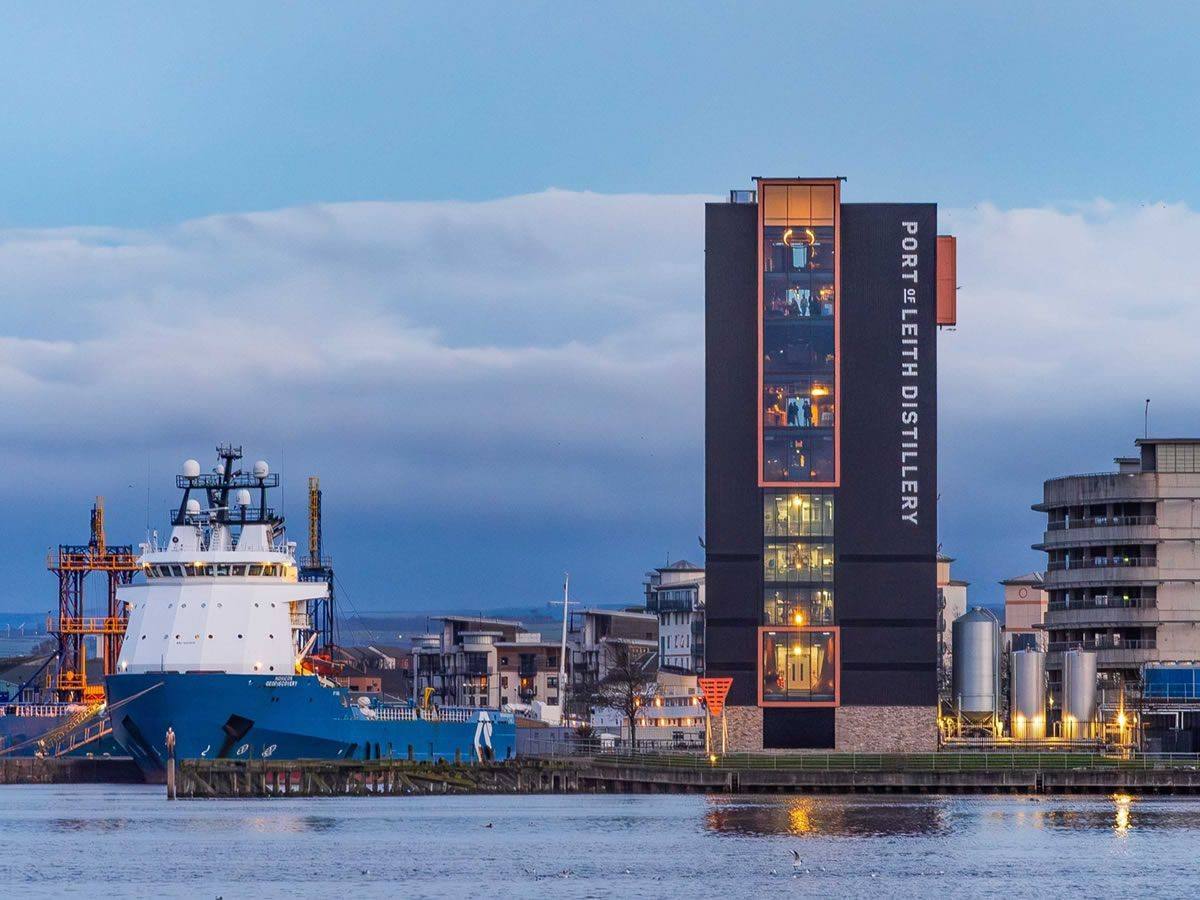
The Port of Leith distillery, designed by ThreeSixty Architecture, is the most radical of the three: a nine-storey tower on Edinburgh's waterfront, the first vertical distillery in the UK. The form was forced by the site, a compact working harbor plot where the only direction available was up. Construction photos show the tower rising over the docks; it opened to visitors on 11 October 2023, with production beginning in January 2024, at a reported cost of £12 million.
The verticality is not a gimmick. The building is organized around gravity: the process descends through the floors, and the top floor holds a bar with views across the Firth of Forth. The founders, Paddy Fletcher and Ian Stirling, spent years on the project, first funding it through the Lind & Lime gin brand, and the barley is single-farm, from East Lothian. The building says the quiet part out loud: a modern distillery can be an urban landmark, not a rural retreat.
At Luss, on the western shore of Loch Lomond, the Loch Lomond Group has taken the opposite approach: adaptive reuse. The distillery occupies a 5,362 square meter site across four buildings, including a repurposed former smokehouse, designed by Paul Hodgkiss Designs. It soft-opened in late 2025 and was officially opened by First Minister John Swinney in February 2026, with the company projecting up to a million visitors in its first full year.
The statement here is about tourism as much as whisky. Luss is one of Scotland's most visited villages, and the distillery is built to receive them: the design works with the existing buildings and the landscape rather than imposing on it. The architect's job was to make a working distillery that reads as part of a conservation village. It is the anti-tower: architecture that disappears into place.
A modern distillery can be an urban landmark, not a rural retreat.
Ardgowan, at Bankfoot near Inverkip, is the third statement. It began distilling in June 2025, the first new distillery in Inverclyde in more than a century, after eight years of planning and construction. In June 2026 it raised £4.2 million in fresh investment to fund the next phase. The buildings take the form of a modern longhouse, low and linear against the Firth of Clyde, and the project has been explicit that the design is part of the brand: a distillery built to be looked at.
Three distilleries, three arguments. Leith says whisky belongs in the city. Luss says it belongs in the landscape. Ardgowan says the building itself is the story. The pagoda roof is not dead, but it no longer has a monopoly. Scotland's new distilleries are being designed by architects, not just engineers, and the results are the most interesting industrial buildings the whisky industry has produced in a generation.
The money behind the statements is serious. Port of Leith's founders spent the better part of a decade getting the tower built, funding the early years through their Lind & Lime gin brand before a drop of whisky was distilled. Ardgowan's £4.2 million raise in June 2026, a year after distilling began, funds the next phase of a site the developers always intended as a destination. These are not vanity projects. They are bets that in a crowded market, the distillery itself, as a place people visit and photograph, is part of the product.