AGAVE
Mezcal's Tax Fight
A 53 percent excise tax is strangling Mexico's artisanal distillers. The industry wants the tax redesigned around how the spirit is made, not how strong it is.
In the palenques of Oaxaca, the most expensive ingredient in a bottle of artisanal mezcal is not the agave, the firewood, or the years of waiting. It is the tax. Mexico's Special Tax on Production and Services, the IEPS, stands at 53 percent for high-alcohol beverages such as mezcal, and when VAT, income tax, and payroll costs are stacked on top, the final price of a traditionally made bottle can carry more fiscal burden than liquid. The people who make mezcal the slow way say the tax, as designed, punishes them for the wrong thing.
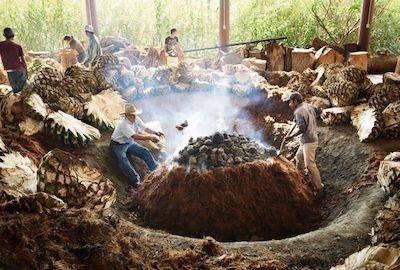
The campaign for change has a name: Moderniza IEPS. The initiative, raised this year by Marisol Rumayor of Mundo Mezcal and Ramón Isaac Pérez of Almas Benditas, does not ask for the tax to be abolished. It asks for it to be redesigned, so that the rate reflects the production process rather than the alcohol content alone. A spirit distilled in a copper still from agave cooked in an earthen pit and crushed by tahona carries, in their argument, a fundamentally different cost structure from an industrially produced bottle, and the tax code should know the difference.
The 53 percent
The IEPS on high-alcohol beverages is calculated primarily on alcoholic strength, a design that dates to an era when the tax was aimed at mass-produced spirits. For small artisanal producers, the effect is regressive. Mezcal made by hand cannot be scaled up or cheapened by machinery without ceasing to be what it is: the tahona, the stone milling, the clay and stone ovens, the labor-intensive work that defines the category. When the tax bites hardest on the producers least able to absorb it, the industry argues, the result is not more revenue but less tradition.
The burden falls hardest in the countryside. The proposals now before Mexico's Chamber of Deputies would exempt artisanal and ancestral mezcal, as defined by the NOM-070 standard, produced at volumes up to 50,000 liters a year in communities classified as highly or very highly marginalized. The logic is straightforward: these are the communities where mezcal production generates employment, preserves tradition, and anchors the local economy, and they are also the producers with the thinnest margins.
What the reform would look like
The reform, as its advocates describe it, is precise. It proposes adding a paragraph to Article 2 of the IEPS law, exempting mezcal in the artisanal or ancestral categories, as defined by NOM-070-SCFI-2016, from the standard rate, capped at 50,000 liters annually and tied to marginalized communities. Production above the cap would be taxed at the standard rate. It is a carve-out, not a repeal: the industrial producers who dominate volume would keep paying, while the small palenques that define the category's reputation would get room to breathe.
Whether it passes is another matter. Mexico's 2026 Economic Package, approved by the Chamber of Deputies in October 2025, showed the government's appetite for excise revenue is undiminished: IEPS rates rose on tobacco, on sugary drinks, and on gambling, with new categories added for good measure. A government that just raised excise taxes across the board is not obviously in the mood to grant exemptions, however well argued.
The tax is calculated on alcohol content. The mezcaleros want it calculated on how the spirit is made.
Why drinkers should care
For the drinker, the stakes are not abstract. Artisanal mezcal is one of the few spirits categories where the traditional end of the market is also the quality end: the bottles that made mezcal famous outside Mexico were made in pits and clay pots, not in column stills. If the tax structure makes the traditional method the uneconomic one, the category does not disappear. It industrializes, and the thing on the shelf stops being the thing the reputation was built on.
The industry's argument, at its core, is that fiscal policy is cultural policy. A tax that cannot tell a tahona from a diffuser will, over time, produce a market with diffusers. The mezcaleros are asking the Mexican state to learn the difference before it is too late. The fight is not about paying less tax. It is about paying tax on the right thing.
From the same shelf